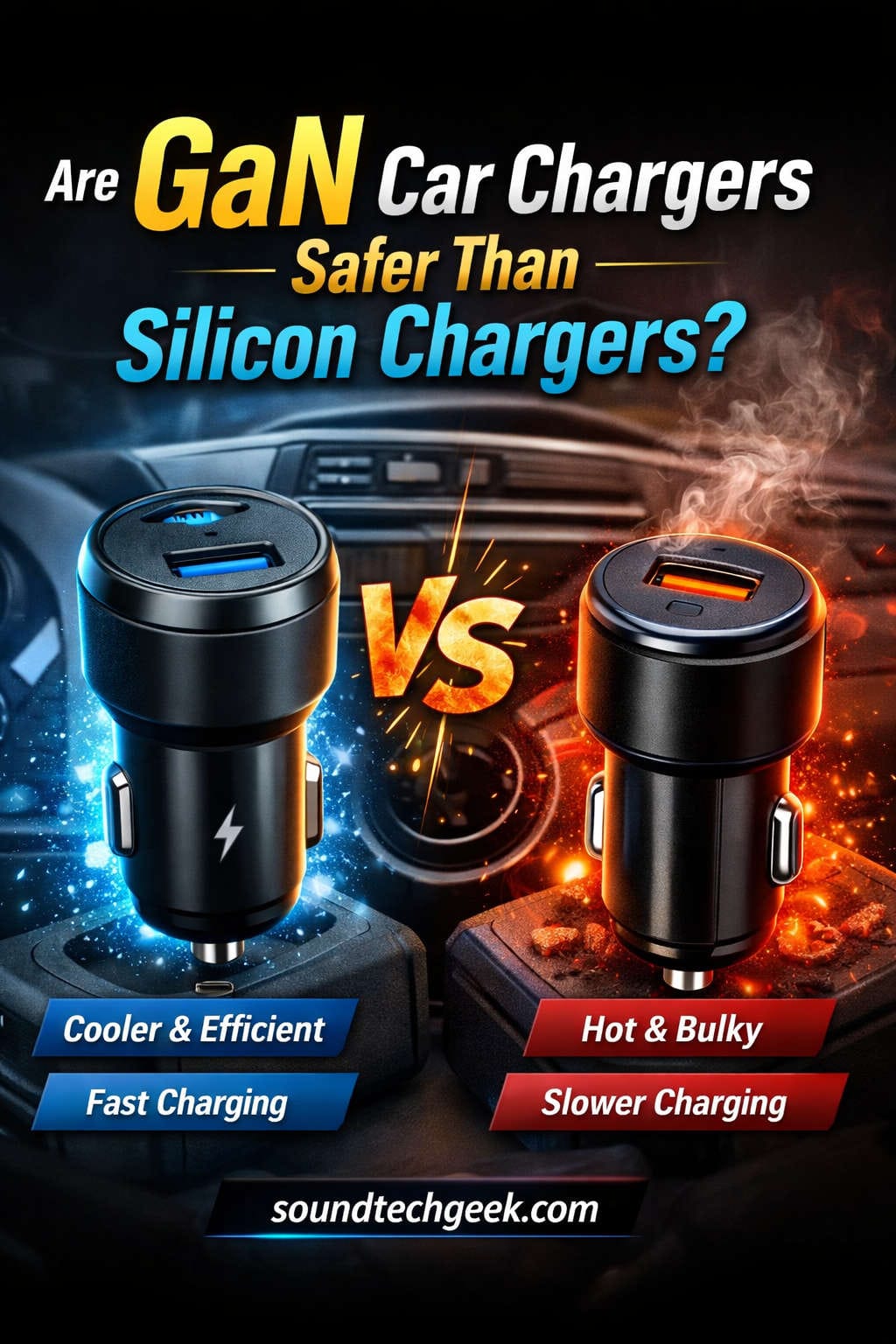
Modern drivers rely on their devices as much as their vehicles. Navigation apps, music streaming, hands-free calls, mobile hotspots, and even laptops now depend on reliable charging inside the car. As charging demands increase, so does the importance of charger safety.
If you’re researching car chargers, you’ve likely come across GaN (Gallium Nitride) car chargers and wondered how they compare to traditional silicon-based chargers. Many brands claim GaN chargers are smaller, faster, and safer—but are those claims actually true?
This in-depth guide explains the real differences between GaN and silicon car chargers, with a strong focus on safety, heat control, durability, and real-world usage, so you can make a confident, informed choice.
Why Car Charger Safety Deserves More Attention
Car chargers may look simple, but they operate in one of the most demanding environments for electronics. Inside a vehicle, chargers are exposed to:
- Fluctuating voltage from the car battery
- High interior temperatures, especially in summer
- Long charging sessions during road trips
- Simultaneous charging of multiple devices
Poor-quality chargers can overheat, deliver unstable power, damage device batteries, or in rare cases, create fire risks. That’s why the internal technology—GaN or silicon—matters more than most people realize.
Understanding Silicon Car Chargers
Silicon has been the standard semiconductor material for decades. Traditional car chargers use silicon transistors to convert the car’s 12V power into safe charging levels for phones, tablets, and other electronics.
Strengths of Silicon Chargers
- Proven and well-understood technology
- Widely available at affordable prices
- Safe when properly designed and certified
Limitations of Silicon Chargers
- Generate more heat during power conversion
- Less efficient at higher wattages
- Require larger internal components
- Performance drops faster under continuous high loads
Silicon chargers are not unsafe by default. However, their limitations become more noticeable as modern devices demand faster and higher-power charging.
What Makes GaN Car Chargers Different?
GaN (Gallium Nitride) is a newer semiconductor material that has transformed power electronics. It can handle higher voltages and switch electricity more efficiently than silicon.
In practical terms, this allows GaN car chargers to deliver more power using smaller components, while producing significantly less heat.
Key Advantages of GaN Technology
- Higher energy efficiency
- Cooler operating temperatures
- Compact and lightweight designs
- Better support for fast-charging standards
- Improved long-term reliability
These advantages directly impact safety, especially in vehicles where heat buildup is a major concern.
Heat Management: The Biggest Safety Difference
Heat is the number one enemy of electronic safety. Excess heat accelerates component wear, increases electrical resistance, and raises the risk of failure.
Silicon Chargers and Heat
Silicon-based chargers lose more energy during power conversion, which turns into heat. Over time, this heat can:
- Degrade internal components
- Cause voltage instability
- Shorten charger lifespan
- Make the charger unsafe to touch
This is especially problematic in hot climates or during long drives.
GaN Chargers and Heat Control
GaN chargers operate with far less energy loss. Because GaN switches power faster and more efficiently, less heat is generated—even at higher wattages.
Lower heat means:
- Reduced risk of overheating
- More stable charging performance
- Longer component lifespan
- Safer operation inside enclosed car spaces
From a safety perspective, cooler operation alone gives GaN a major advantage.
Charging Stability and Power Regulation
A safe charger must deliver consistent, well-regulated power. Sudden voltage spikes or drops can damage device batteries and internal circuits.
How Silicon Handles Power Regulation
Silicon chargers regulate power reliably at lower loads. However, under heavy use—such as charging multiple devices—their response can be slower, leading to minor voltage fluctuations.
How GaN Improves Stability
GaN technology switches power at higher frequencies, allowing faster and more precise voltage control. This results in:
- Smoother power delivery
- Better compatibility with fast-charging protocols
- Less electrical stress on connected devices
For modern smartphones, tablets, and laptops, this stability translates into better battery health and safer charging.
Size, Design, and Internal Safety Layout
GaN chargers are noticeably smaller than silicon chargers with similar power output. This isn’t just about convenience—it also affects safety.
Smaller components allow manufacturers to:
- Design cleaner internal layouts
- Reduce unnecessary wiring
- Improve airflow and heat dissipation
- Add more advanced safety circuits
Silicon chargers need larger components to manage heat, which can limit design flexibility and increase internal stress points if not engineered carefully.
A well-designed GaN charger uses its compact size to enhance—not compromise—safety.
Durability and Long-Term Safety
Safety isn’t only about how a charger performs today—it’s also about how it behaves after months or years of use.
Silicon Charger Longevity
Repeated heat exposure slowly weakens silicon components. Over time, this can lead to:
- Reduced efficiency
- Increased heat output
- Higher failure risk
GaN Charger Longevity
Because GaN chargers run cooler, they experience less thermal stress. This leads to:
- More consistent performance over time
- Lower risk of internal damage
- Longer usable lifespan
From a long-term safety perspective, GaN chargers are generally more durable and reliable.
Real-World Driving Scenarios
Daily Commutes
For short trips and basic phone charging, both silicon and GaN chargers perform adequately. However, GaN still operates cooler and wastes less power.
Long Road Trips
Extended charging sessions, navigation use, and multiple devices push chargers harder. GaN chargers handle these conditions more safely due to better heat control.
Multi-Device Charging
Charging a phone, tablet, and power bank at once can overwhelm cheaper silicon chargers. GaN chargers manage high combined loads with less heat buildup.
Built-In Safety Features That Matter
Regardless of technology, a safe car charger should include essential protections. High-quality GaN chargers usually include these by default:
- Over-voltage protection
- Over-current protection
- Short-circuit protection
- Over-temperature protection
- Smart device detection
- Fire-resistant outer casing
Silicon chargers can include these features too, but premium GaN models often implement them more effectively due to superior thermal performance.
Common Myths About GaN Car Chargers
“GaN chargers are risky because they’re new”
GaN technology has been used for years in aerospace, data centers, and electric vehicles. It is mature, tested, and highly reliable.
“GaN chargers damage batteries”
High-quality GaN chargers regulate power more precisely, which can actually help preserve battery health.
“Silicon chargers are unsafe”
Silicon chargers are safe when well-made and certified. The difference is that GaN handles modern charging demands more efficiently.
How to Choose the Safest Car Charger
When shopping for a car charger, focus on quality—not just the material.
Safety-Focused Buying Checklist
- Choose well-known, reputable brands
- Look for safety certifications
- Match wattage to your device needs
- Prefer GaN for fast charging and multiple devices
- Avoid extremely cheap, unbranded chargers
- Read user reviews for heat performance
If you frequently charge laptops, tablets, or multiple devices, GaN is the safer and more future-proof choice.
Are Silicon Chargers Still Worth Using?
Yes—especially for basic, low-power charging needs. A certified silicon charger from a reputable brand can still be perfectly safe for phones and small accessories.
However, as devices demand higher power and faster charging, silicon chargers struggle to keep up efficiently. In those cases, GaN chargers clearly outperform them in both safety and performance.
The Future of Car Charging Technology
The industry is rapidly shifting toward GaN-based solutions. As production costs decrease, GaN chargers are becoming more affordable and widespread.
Future GaN chargers will likely offer:
- Smarter thermal monitoring
- Adaptive power delivery
- Higher efficiency with lower environmental impact
This shift isn’t just about speed—it’s about safer, cleaner, and more reliable charging.
Final Verdict: Which Is Safer?
In a direct comparison between well-built chargers:
GaN car chargers are generally safer than silicon car chargers, especially for:
- Fast charging
- High-power devices
- Long charging sessions
- Hot vehicle environments
Their superior efficiency, cooler operation, and better voltage control reduce the most common safety risks associated with car charging.
That said, quality still matters more than labels. A poorly made GaN charger can be unsafe, while a premium silicon charger can be perfectly reliable. Always prioritize certification, brand reputation, and real-world performance.
If you want the safest, most efficient, and most future-ready option for charging in your car, GaN technology is the smarter choice.